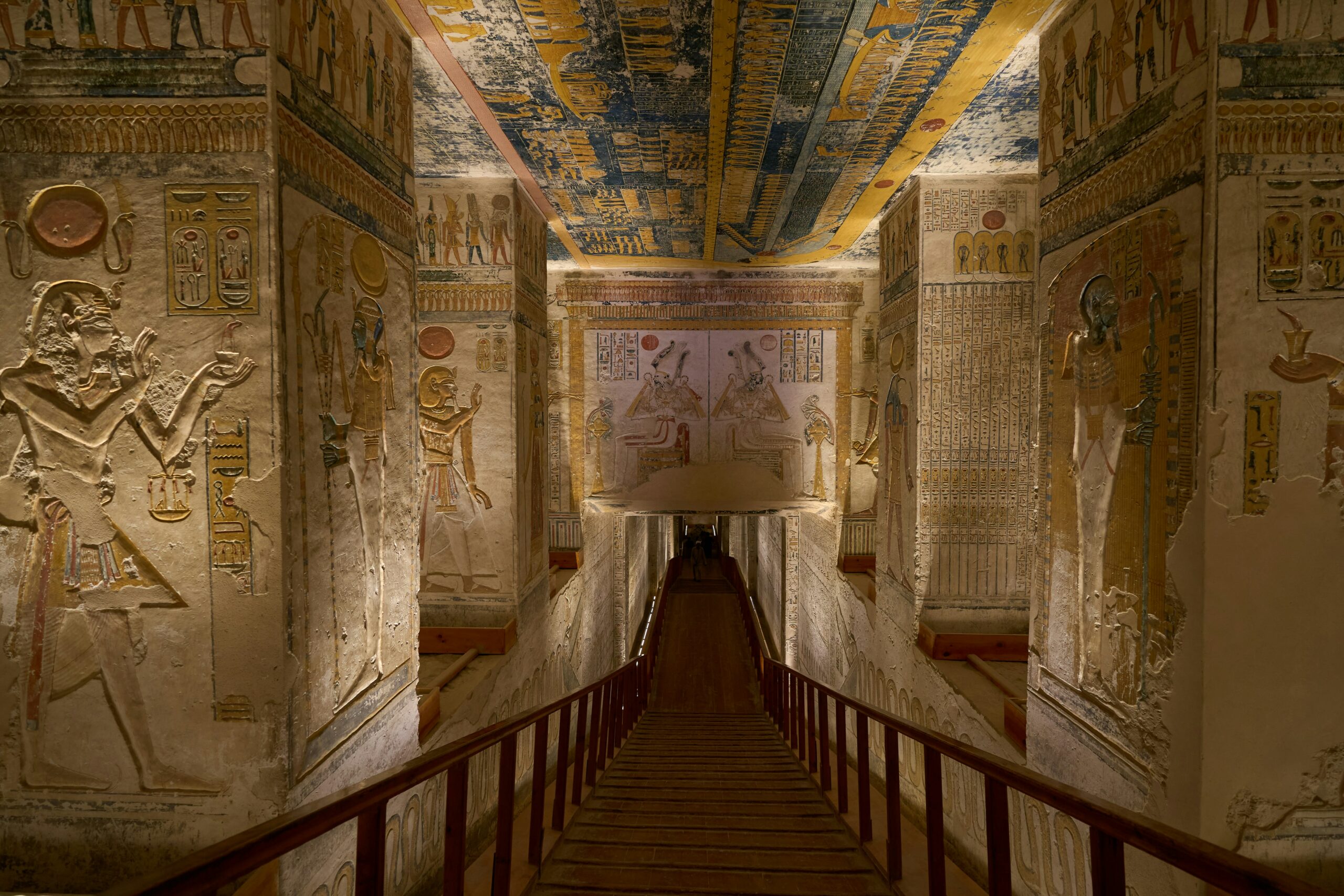
Luxor, Egypt — Archaeologists have unearthed the tomb of a previously unknown royal figure in Egypt’s Valley of the Kings, a discovery that is forcing a reassessment of the role of elite women during the twilight of the New Kingdom. The tomb, which dates back roughly 3,200 years, was found hidden beneath a collapsed rock shelter in the western necropolis of Luxor, near the famed tomb of Pharaoh Seti I.
The burial chamber contains the remains of a high-ranking woman identified as Neferet-Hathor, a name that translates to “Beauty of Hathor.” While her exact title remains debated, surviving inscriptions and funerary goods suggest she was a priestess or “God’s Wife of Amun,” one of the most powerful religious offices available to women in ancient Egypt.
“This is not just another tomb,” said Dr. Amina Khalil, the lead archaeologist from Egypt’s Supreme Council of Antiquities, in an exclusive interview at the dig site. “We are looking at evidence of a woman who wielded significant influence in a period where female agency is often underestimated. The inscriptions mention her involvement in temple administration, which is rare for a non-royal burial.”
The team uncovered the entrance after noticing a shift in the bedrock during routine excavation work for a new visitor pathway. Inside a single, undecorated chamber, they found a fragmented limestone sarcophagus, a cache of amulets, painted wooden canopic jars—used to store internal organs—and a set of silver bracelets engraved with hieroglyphs. Preliminary radiocarbon dating places the burial during the 20th Dynasty, roughly 1186–1069 B.C., a time of political fragmentation and economic decline.
A Window into a Forgotten Elite
The find is significant for several reasons. First, it provides physical evidence of the “God’s Wife of Amun” institution during a period of decline, when royal power was waning in the south and the priesthood of Amun was consolidating control over Upper Egypt. Second, the tomb’s placement in the Valley of the Kings—traditionally reserved for pharaohs and their immediate family—suggests that Neferet-Hathor held a status far beyond her noble birth.
“Women in the Ramesside period were more than wives or mothers,” explained Dr. Thomas Greaves, a professor of Egyptology at the University of Oxford not involved in the excavation. “This discovery supports the idea that some noblewomen managed vast temple estates and controlled considerable wealth. It challenges the assumption that female power in Egypt was limited to the likes of Hatshepsut or Cleopatra.”
What Lies Ahead
The excavation is only partially complete. Researchers believe a second, deeper chamber may still lie beneath the debris, potentially containing the mummy itself and additional funerary texts. The Egyptian Ministry of Tourism and Antiquities announced it will begin a conservation project for the artifacts, which are expected to be displayed at the Luxor Museum within the next two years.
For now, the discovery of Neferet-Hathor is forcing scholars to reconsider who held power—and how—during one of Egypt’s most turbulent centuries. It is a reminder that history’s silence is often a matter of what has yet to be found, not what never existed.
This article is based on reporting from Luxor and interviews with archaeological teams. For further reading, see “Women in Ancient Egypt: Roles and Realities” (Oxford University Press, 2020).