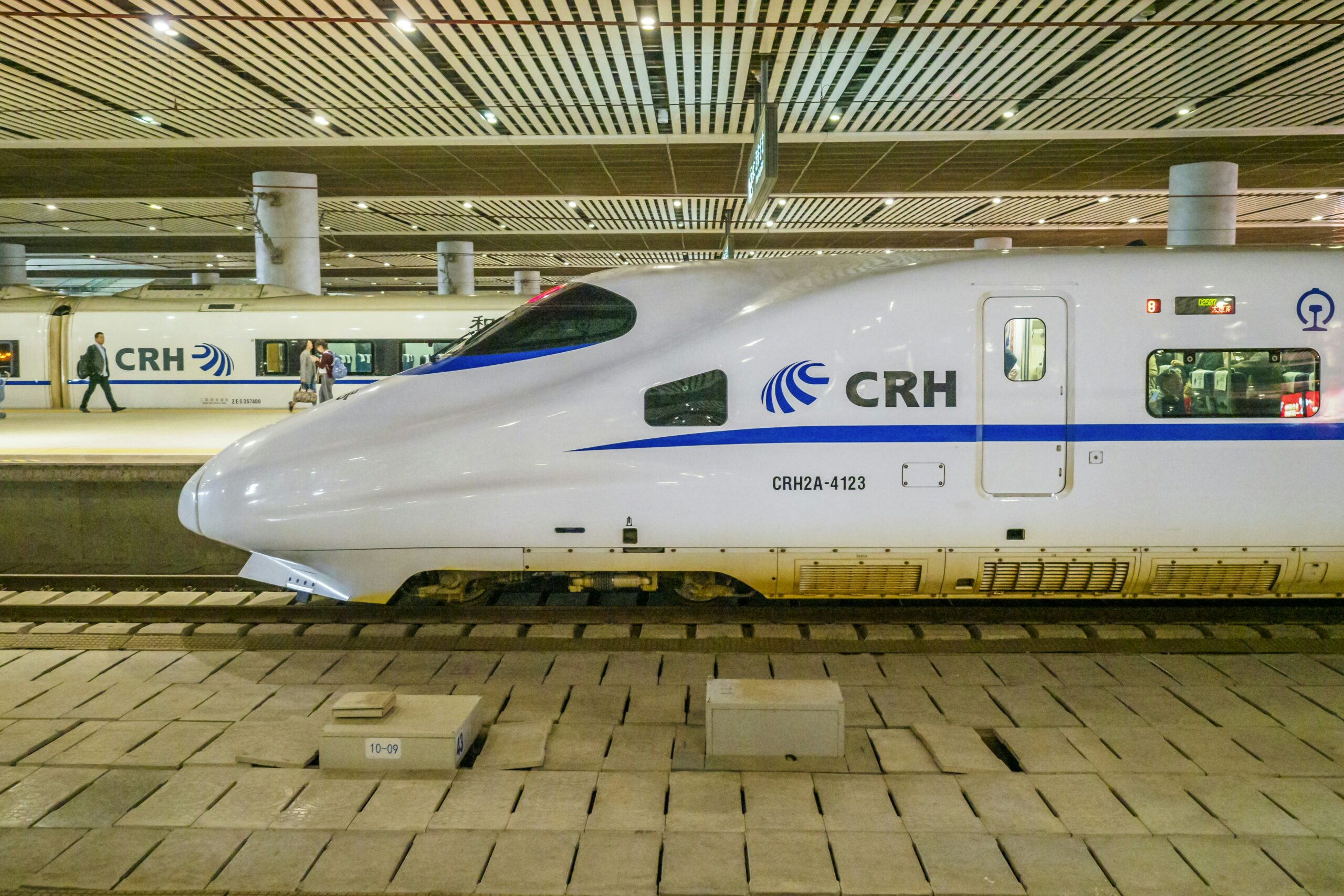
A recent documentary series offered an in-depth exploration of the transformative 100-year history of China’s rail system, tracing its evolution from early, challenging construction feats to cutting-edge, autonomous high-speed networks. Hosted by television presenter Janis Chan, the program, Infinite Road V – Wisdom for the Frontier, specifically spotlighted the development of the crucial Beijing-Zhangjiakou railway line and the rapid advancements in domestic high-speed rail technology.
The focus began with the original 京張鐵路 (Jingzhang Railway), completed in 1909 as China’s first domestically engineered track. Chan visited the historic 117-year-old Qinglongqiao Station, often described as an “antique station,” to highlight the ingenuity required for its initial operation. Early steam locomotives lacked the power to ascend the steep gradients of the Badaling mountain range. To overcome this, Zhan Tianyou, widely regarded as the “Father of China’s Railroads,” devised the groundbreaking switchback design—a distinctive “人” (human-shaped) zigzag configuration. This allowed trains to use added locomotive power at both the front and rear, reversing direction to navigate the challenging elevation change.
Fast forward a century, and the original Jingzhang line has been replaced by the New Jingzhang High-Speed Railway. This modern route showcases the staggering progress achieved, increasing operating speeds from the original 35 kilometers per hour to an impressive 350 kilometers per hour. More significantly, the new line holds the distinction of being the world’s first smart high-speed railway to integrate the Beidou Navigation System and offer fully autonomous (driverless) 5G operations.
The program also provided a look behind the scenes at the manufacturing epicenter of China’s high-speed trains in Changchun, Jilin province. While early models like the Harmony series relied heavily on foreign technology transfer, Chinese engineers quickly focused on developing proprietary systems tailored to the nation’s diverse geography, climate, and vast transit demands.
This push for self-reliance culminated in 2017 with the introduction of the Fuxing (Rejuvenation) series, China’s first wholly indigenous high-speed train. This marked a crucial “breakthrough from zero” in proprietary high-speed rail technology. Engineers confirmed that the Fuxing trains are now routinely manufactured and deployed across the national network, signaling a new milestone in rail independence. Furthermore, the team is actively developing a Fuxing 2.0 version, aiming to achieve target speeds of 450 kilometers per hour.
Beyond conventional high-speed rail, the documentary noted successful trials with new generation magnetic levitation (maglev) train technology. These new prototypes have achieved speeds up to 600 kilometers per hour. Such speeds promise fundamental changes to domestic travel times; for instance, the journey between Beijing and Shanghai could potentially be slashed from the current four hours to a mere two hours. This establishes maglev as a future transport option positioned strategically between existing high-speed rail and air travel, potentially reshaping intercity connectivity across the nation.
The rapid, sustained development—from overcoming fundamental engineering hurdles with steam power to implementing AI-driven, 5G intelligent rail—underscores China’s commitment to leveraging technological autonomy to redefine large-scale public transportation infrastructure.