LONDON, ENGLAND— Researchers are employing sophisticated artificial intelligence (AI) models to forecast potentially disruptive solar flares and coronal mass ejections (CMEs), offering the world a crucial early warning system against events that can cripple modern technology, according to a new report. This innovative approach integrates vast amounts of solar data with deep learning algorithms, significantly improving predictive accuracy and reducing the lead time necessary for protecting satellites, power grids, and communication systems reliant on sensitive electronics.
The Urgent Need for Space Weather Prediction
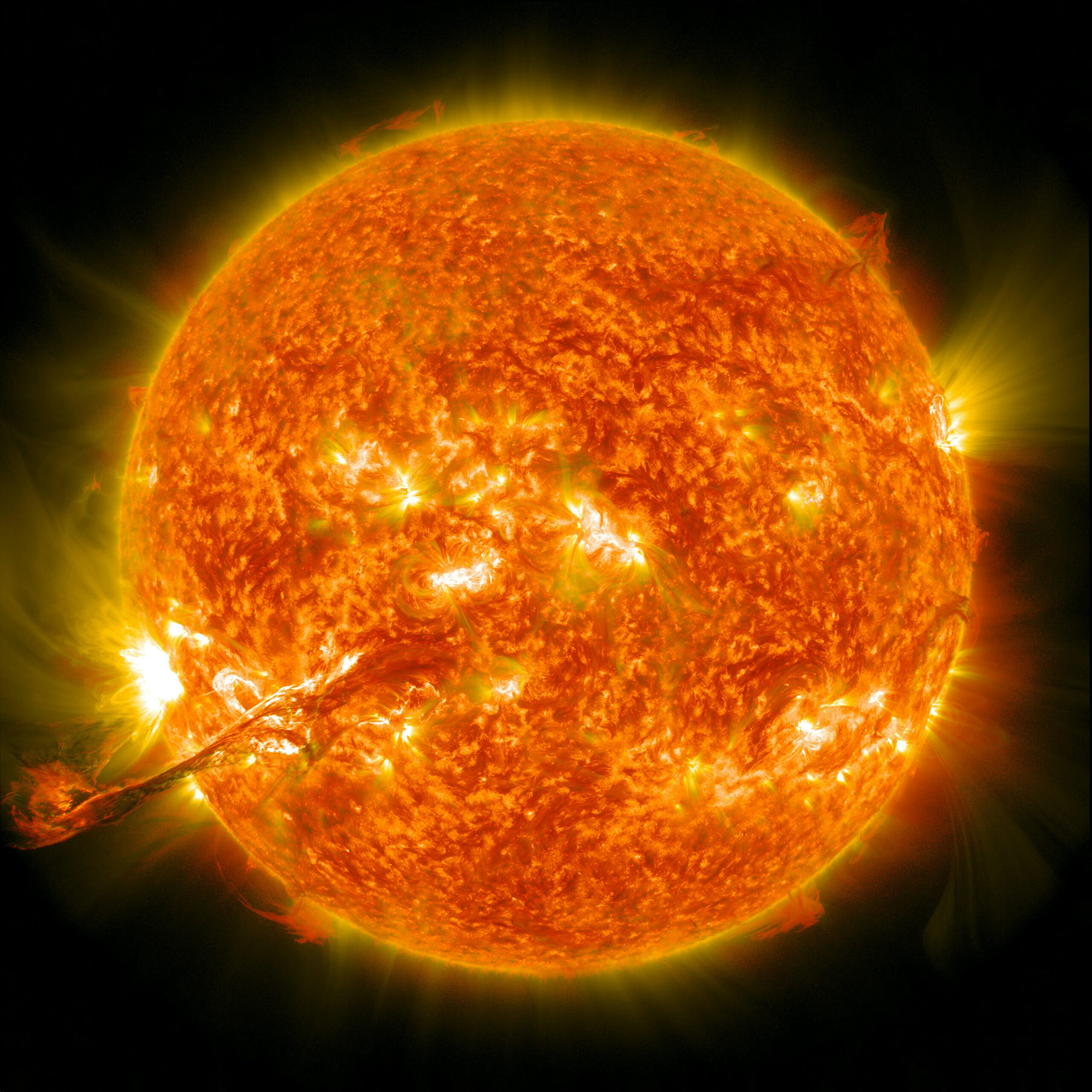
The Sun constantly emits radiation, but powerful solar storms occasionally blast billions of tons of plasma toward Earth. When a Coronal Mass Ejection impacts the planet’s magnetosphere, it induces geomagnetic storms that pose serious threats to terrestrial infrastructure. Perhaps the most famous example is the 1859 Carrington Event, a storm so intense it caused telegraph lines to short out and spark fires; if a storm of similar magnitude happened today, the economic damage could run into trillions.
Traditional methods of space weather forecasting rely heavily on visual observation and complex physics-based simulations, which often lack the speed and predictive consistency needed for rapid intervention. Solar activity must be monitored constantly, and a major eruption can travel across the approximately 93 million miles to Earth in as little as 15 to 18 hours, leaving a narrow window for preparation.
The breakthrough lies in feeding high-resolution images and magnetic field measurements from solar observation spacecraft—such as NASA’s Solar Dynamics Observatory (SDO)—into AI systems trained to recognize the subtle precursors of solar flares. These patterns, often invisible or too fast to register consistently via human analysis, are reliably flagged by the algorithms.
How AI Enhances Forecasting Accuracy
The new AI models, often referred to as machine learning or deep learning tools, analyze thousands of historical solar eruptions to identify key characteristics associated with instability in sunspot regions—the cooler, magnetically active areas where flares originate.
Scientists are particularly focused on predicting the timing and magnitude of X-class and M-class flares, the strongest categories capable of causing significant disruption. The primary benefit of the AI integration is speed. Where complex numerical simulations might take hours to process and refine, the AI can deliver a high-probability prediction within minutes of observing the developing magnetic configuration on the Sun’s surface.
For utilities and satellite operators, this early insight is invaluable:
- Satellite Protection: Operators can place satellites into “safe mode,” turning off unnecessary electronics or adjusting orbits to minimize radiation exposure.
- Power Grid Resilience: Utility companies can proactively disconnect transformers or adjust loads to prevent massive power surges that can damage equipment and cause cascading blackouts.
- Communication Stability: Aviation and military operations can prepare for temporary disruptions to high-frequency radio and GPS signals, which travel through the ionosphere affected by solar radiation.
Building a Global Warning Network
While AI is significantly enhancing the prediction phase, the system is only as good as the subsequent action taken globally. Major space weather agencies, including the US National Oceanic and Atmospheric Administration’s Space Weather Prediction Center (SWPC) and the European Space Agency (ESA), are working to integrate these AI-driven forecasts into their operational models.
The continued development of these AI tools promises to transition space weather prediction from a reactive alert system to a proactive forecasting capability, similar to terrestrial weather forecasting. Future research aims to extend the predictive window to several days, providing ample time for extensive preparations crucial for the technological integrity of modern society. As humanity becomes increasingly reliant on space-based technology, accurately anticipating the Sun’s fury is no longer a luxury, but an absolute necessity.